archive
sustainability

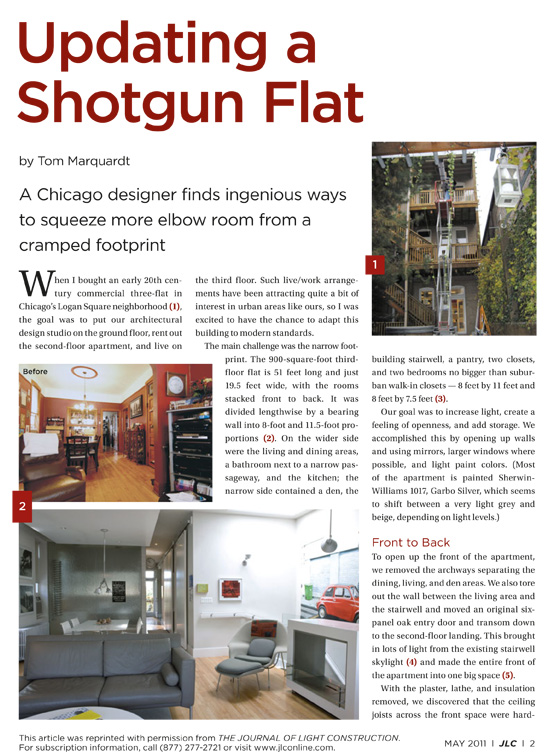
Did you know that Tom has also written magazine articles? Here is one for the Journal of Light Construction detailing the design process of updating a cramped, maze-like shotgun apartment into a modern, airy flat.

To see the whole article download the pdf. For more information on the Chicago Shotgun Flat design and renovation, please see our case study.

Read More

marquardt+ developed a complete interior and exterior brand overlay presentation system for 11 of Tetra Pak’s North American facilities, as part of the implementation of their new international rebranding strategy. New elements included approved interpretations of the new Tetra Pak logo, messaging and packaging displays in environmental graphics, wall treatments, landscape design, flooring lighting, painting and furniture strategies and intranet information portals. The initial implementation shown has been implemented to their Denton, TX facility and portions of the Vernon Hills, IL US Headquarters.

Tetra Pak also asked m+ for help with a Green Information Portal. This was an area in each facility that could work like a bulletin board for all things sustainable, and encouraged everyone of any level to engage in the process of making the company greener.


See more of the brand overlay and the green information portal at our website!

* work performed as Design Collaboratives

Read More

by James Wild, Gridwerk Architecture

In response to the NY Times Article, ‘A City Prepares for a Warm Long-Term Forecast’
that was published on June 6th, 2012

Regardless of warmer or cooler climate change predictions, the use of permeable paving systems and high solar albedo surfaces that reflect more solar energy are the key to reducing solar gain on heat islands in relation to water run-off in the spring and the summer.

The Chicago City Sewers are historically over-taxed. The overflow consistently runs into the lake, resulting in grey or black water runoff polluting our primary source of drinking water… Didn’t they reverse the Chicago River because of this about 100 years ago?

While the City has employed the ongoing deep tunnel project to reduce water run-off and manage the sewer overflow, they have only slowly began to balance this strategy with a change in the city’s surface and sewer infrastructure, which is key to properly solving these issues.

Due to this history, whether temperatures increase or decrease in the future is not the argument. What needs to be discussed is what strategies should Chicago employ, and in turn, which the City should prioritize, seek approval on and implement.

Currently, the State of Illinois EPA is offering a grant program to portions of the city specifically designed for the reduction of pollution and water run-off into our waterways.

Sadly, our very own Logan Square has one of the largest annual sewer run-offs in the city. To address this issue, the Metropolitan Planning Council worked with the neighborhood to form the Milwaukee Avenue Green Development Corridor, of which I am a member.

Unfortunately, this is only a pilot program. The money currently being offered is criminally small. It is up to the success of programs like this to continue funding or discontinue funding. With governmental agencies buckling down, including the City of Chicago, the challenge is how to sustain the momentum of implementing these changes.

It is our professional and civic responsibility to push these agendas forward. Please join us in the effort! If we are having this problem prior to climate change, imagine what could happen if temperatures increase as scientifically predicted in this article!

Read More

James Wild of sister firm Gridwerk Architecture is currently participating on the Milwaukee Avenue Green Development Corridor Committee. The committee is investigating ways to help increase sustainability and reduce water management in Logan Square and along the Milwaukee Corridor through a grant from the State of Illinois.

On March 13, at 7:00pm, the committee is hosting a public workshop at the newly completed Hairpin Lofts (2800 North Milwaukee Avenue) to discuss how the grant program works and how you can take part in making green improvements to your property.

Participants will get free consultations from design professionals on the kinds of projects that make sense for their home or business, including green roofs, rain garden, permeable pavers and more!

For more information please check out the Milwaukee Avenue Green Development Corridor Committee event website!

Read More

We here at marquardt+ have always been very interested in sustainability, but our first pass is always towards the passive house end (proper insulation, overhangs, sitting the house appropriately to the sun,) rather than the active end (solar panels, geothermal pumps, etc.) Don’t get us wrong, there is definitely a place for our new technology in homes, we just think those should be added only if necessary.

Here are the first renderings of concepts for homes marquardt+ is developing that will meet PassivHaus initiatives. These design conceptualizations were created and developed by our very own Vince Gammino for marquardt+ to develop further. They show a return to a more space-efficient, low-slung and intelligently constructed home. Our team will include Tom, Vince, Jim Wild, Gretchen Miller, and Mark Rupsis.

The Passive House is a very well-insulated, virtually air-tight building that is primarily heated by passive solar gain and by internal gains from people, electrical equipment, etc. Energy losses are minimized. Any remaining heat demand is provided by an extremely small source. Avoidance of heat gain through shading and window orientation also helps to limit any cooling load, which is similarly minimized. An energy recovery ventilator provides a constant, balanced fresh air supply. The result is an impressive system that not only saves up to 90% of space heating costs, but also provides a uniquely terrific indoor air quality, even in the most brutal weather. During the more temperate spring and fall, windows are all operable to allow for cross-ventilation, fresh air flowing through the home.

We are in the process of developing a series of designs, and will update you all with more floor plans and performance specifications as we move forward!
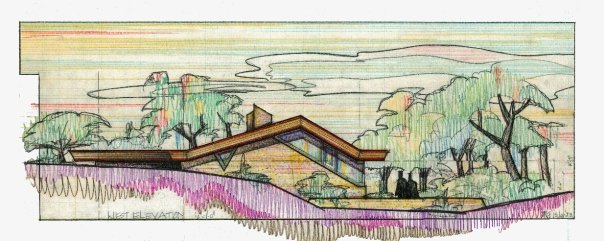

BermHouse – Elevation

Keeping homes low to ground (1 floor or more minimal level shifting), partially bermed, and properly oriented with strategically positioned overhangs and exposures reduce the building’s demand for heating, cooling and energy consumption.
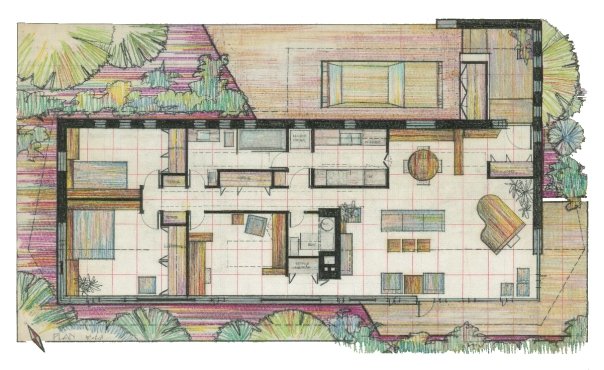

BermHouse – Plan

Efficient space planning lowers square footage requirements, allowing for efficiency and better use of materials. Our goal for the new economy is to create more beautiful, livable space, that reduces waste, controls temperature and airflow and reflects a more intelligent way to design homes within the environment. All this is achieved without compromising quality of life or engagement with outside space.
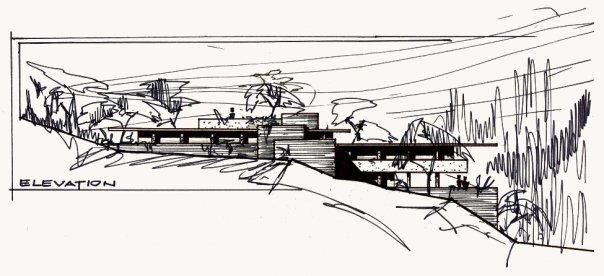

HillHouse – Elevation

These building techniques do not limit design potential. Designs utilize massing and sensitivity to the landscape and a respect for materials. Houses can respond to the topography of a location with a minimum of intervention.
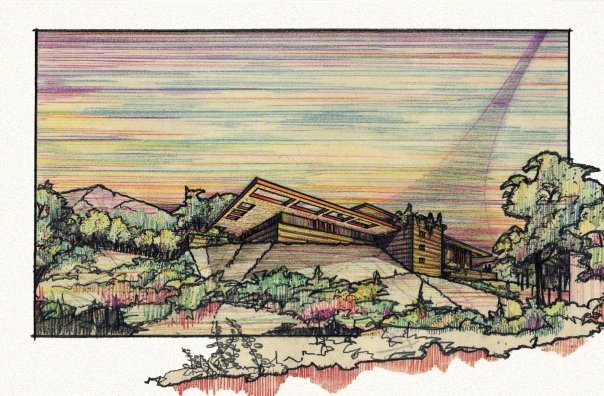

HillHouse – Perspective

Overhangs and wall constructions and thicknesses contribute the the efficiency of the homes.
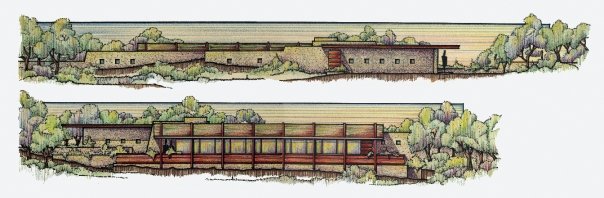

LongHouse – Elevations

Orientation to light gain and airflow can dictate solidity and transparency of the home, and create new ways for design to respond to the environment, efficiencies and living experiences.

Read More